Can a Herniated Disc Heal Without Surgery? A Physiotherapist's Complete Guide
“The MRI showed a herniated disc” — that sentence stirs the same fear in most people: “Will I need surgery?” Yet current science offers an answer that is, contrary to expectation, quite reassuring. A herniated disc is a common condition, it usually improves without surgery, and in a great many people it causes no symptoms at all. This article takes a comprehensive look at what a herniated disc is, why it is not as dangerous as feared, how it is addressed in physiotherapy, and when there is genuine cause for concern.
What is a herniated disc?
Between our vertebrae sit structures called discs, which act as cushions. Each disc has a firm outer wall and, inside it, a soft, gel-like core. A herniated disc is this core bulging or seeping outwards through a weak point in the outer wall. The problem begins when this protruding part presses on, or irritates, a nerve passing nearby — and this is most often the true source of the pain.
Does every herniated disc cause pain?
No — and this is one of the most important facts. Herniated discs are found very often on the MRI scans of people with no complaints whatsoever. In a large proportion of people without symptoms, imaging can show a disc bulge or a herniation. So the word “herniation” on an MRI report does not, on its own, mean it is the definite cause of your pain. What matters is assessing the person’s actual complaints, not the herniation on the image.
What are the symptoms? What is sciatica?
The most typical symptom of a herniated disc is pain that is often felt more in the leg than in the back. When the herniation presses on a nerve, the pain can start in the buttock and spread down the back of the leg, sometimes as far as the foot; this is known, both in everyday language and in medicine, as sciatica. The pain can be accompanied by numbness, tingling, or slight weakness in that leg. Symptoms may worsen with coughing, sneezing or prolonged sitting — because these temporarily raise the pressure on the nerve.
What does a herniation on an MRI actually mean?
There is a common misconception here: “The bigger the herniation, the more serious the situation, and the more surgery is needed.” Research shows this is not true. The size of a herniation on an MRI does not, on its own, reliably predict how much pain you will have or whether you will need surgery. There is even an intriguing fact: large, extruded-looking herniations sometimes have a higher chance of regressing on their own than smaller ones. This is why treatment decisions are made according to the person’s symptoms and assessment, not the MRI image.
Can a herniated disc heal without surgery?
Here is the article’s most pressing question — and the answer is reassuring. Research shows that the great majority of leg pain caused by a disc herniation (sciatica), around 90% across various studies, improves with conservative care and without any need for surgery. In most patients this improvement begins within the first six weeks and generally becomes marked within three months. Looking at the longer term, the outcomes of patients who had surgery and those who did not are often similar at one to two years. In other words, the non-surgical route is not merely an “alternative” for most people; it is the first and often sufficient choice.
Can the disc shrink on its own? (Resorption)
Surprising but true: the body can gradually reabsorb and shrink herniated disc tissue. This is called resorption. Your immune system begins to recognise the protruding tissue almost as a “foreign material” and to clear it away; the cells that arrive at the area, along with new blood vessels, can cause the herniation to regress over time. This is one of the biological explanations for why so many herniations improve without surgery — while you wait, it is not that nothing is happening; most often the body is carrying out its own repair.
How is it assessed in physiotherapy?
The right treatment begins with the right assessment. In physiotherapy the aim is to understand whether the pain truly comes from the herniation or from another back problem, which nerve is affected, and how serious the presentation is. This involves the history (where the pain spreads, what worsens it, what eases it), a movement examination, and tests that assess nerve function. This assessment also screens for the symptoms known as “red flags”, which call for prompt medical attention.
What is watched for?
An important part of the assessment in disc herniation is reading the behaviour of the pain: which positions worsen or ease it, how the nerve symptoms are progressing, how much daily life is affected. Changes over time in the strength and sensation of the leg are followed particularly closely — because these show both how treatment is progressing and, rarely, the early sign of a more serious situation.
How is it treated?
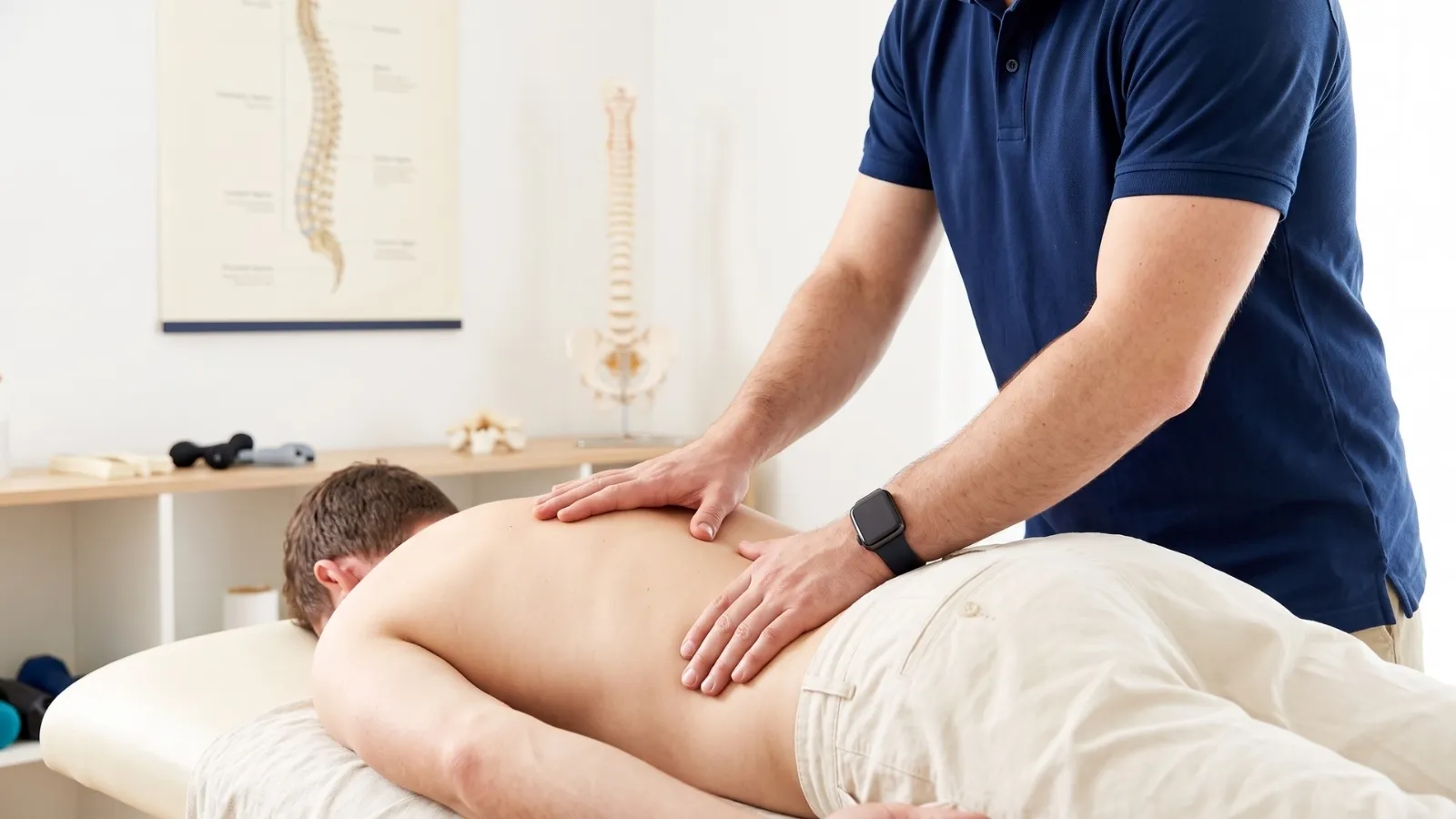
In a herniated disc, physiotherapy is not a single technique but a whole. In the early phase the aim is to manage the pain and to keep the person moving as much as they can tolerate; because complete rest usually slows recovery down rather than speeding it up. As the process moves on, manual therapy to ease the movement of the lower back and surrounding tissues, techniques that support the free movement of the irritated nerve (neural mobilisation), and a graded strengthening programme all come into play. The aim is not just to settle the pain of the moment; it is to get the back working strongly, resiliently and without pain again.
How are exercises chosen?
With a herniated disc, there is no such thing as “the same exercise for everyone”. The right exercise is chosen according to the stage the person is in, which movement worsens their pain, and what they can tolerate. Movements in a particular direction may ease the pain in one person while causing discomfort in another. The exercise programme therefore rests on assessment and is updated as the process goes on, in line with the person’s response — it is not a fixed prescription but a living plan.
How long does recovery take?
This is one of the most-asked questions, and the honest answer is “it varies from person to person”. A general framework can still be given: in most patients with acute sciatic pain, symptoms begin to ease markedly within the first six weeks and largely settle within about three months. For some the process is shorter, for others longer. What matters is knowing that recovery is often not a straight line but a road with ups and downs — and staying active in the right way throughout it.
When is surgery considered?
The decision for surgery is one a surgeon makes, assessing the person as a whole; the purpose of this article is not to direct it. The general trend in the literature, however, is this: surgery mostly comes into question in particular situations — unrelenting pain that persists despite several months of proper conservative care, or progressive, marked muscle weakness. For a great many people outside these situations, a structured physiotherapy process is the first and often sufficient step. For an overview of the lower back and the treatment approach, see the Lower Back Pain page.
When is immediate assessment needed?
The vast majority of herniated discs are not dangerous; but one rare situation calls for assessment without delay. If any of the following are present, medical attention should be sought immediately: a sudden loss of bladder or bowel control, numbness around the back passage and the inner thighs (saddle-area numbness), or rapidly progressing weakness in both legs. These can be signs of a rare but time-critical condition known as cauda equina syndrome.
How can recurrence be prevented?
Once a herniated disc has settled, the question that comes to mind is “will it come back?” While recurrence cannot be prevented outright, the way to reduce the risk is clear: keeping the muscles that support the back and trunk regularly strong, reviewing daily habits that place excessive strain on the back, and maintaining an active life. The final phase of physiotherapy usually targets exactly this: not just settling the current episode, but building the back’s resilience for the future.
References
- Lumbar Disc Herniation — StatPearls / NCBI.
- Surgery vs Conservative Care for Sciatica — NEJM (2020).
- Acute Lumbar Disk Pain — AAFP review (90% conservative recovery).
- Spontaneous Resorption of Lumbar Disc Herniation — systematic review (PMC).
Frequently Asked Questions
Can a herniated disc heal without surgery?
Most of the time, yes. Studies show that around 90% of leg pain caused by a disc herniation improves with conservative care, without surgery. Surgery only comes into question in selected situations.
My MRI shows a large herniation — does that mean I definitely need surgery?
No. The size of the herniation on its own does not mean surgery is needed; in fact, large herniations sometimes regress more than small ones. The decision is based on symptoms and assessment, not on the size.
With a herniated disc, should I rest in bed or keep moving?
Generally, staying active within the limits you can tolerate is better than prolonged bed rest. Complete rest usually slows recovery down. The right balance is determined through assessment.
Can a herniation shrink on its own?
Yes. The body can gradually reabsorb and shrink herniated disc tissue (resorption); this is one of the biological processes that explains why so many herniations improve without surgery.
You can book an appointment to assess your lower back and discuss suitable treatment options.
Related Posts

What Is Lumbar Spinal Stenosis? A Physiotherapist's Complete Guide
Lumbar spinal stenosis is usually managed without surgery. Leg pain worse with walking, relieved by bending forward, exercise, and when surgery is considered.
What Is Spondylolisthesis (Slipped Vertebra)? A Physiotherapist's Complete Guide
Spondylolisthesis (slipped vertebra) is usually managed without surgery. Symptoms, grades, stabilisation exercise, what to avoid and when surgery is an option.

What Is Sacroiliac Joint Pain? The Condition Often Mistaken for Back Pain
Sacroiliac joint pain is often confused with a herniated disc or sciatica. Its symptoms, how it differs from back pain, diagnosis and the role of physiotherapy.
This content is for informational purposes only. It is not intended as medical advice. Please consult your physician and physiotherapist for any health concerns.